
Rhodiola rosea has become one of the most popular adaptogenic supplements on the market — commonly used to support stress resilience, cognitive performance, mood, fatigue reduction, and physical endurance.
But recent laboratory testing has revealed a concerning issue within parts of the market: elevated lead contamination in some rhodiola rosea products.
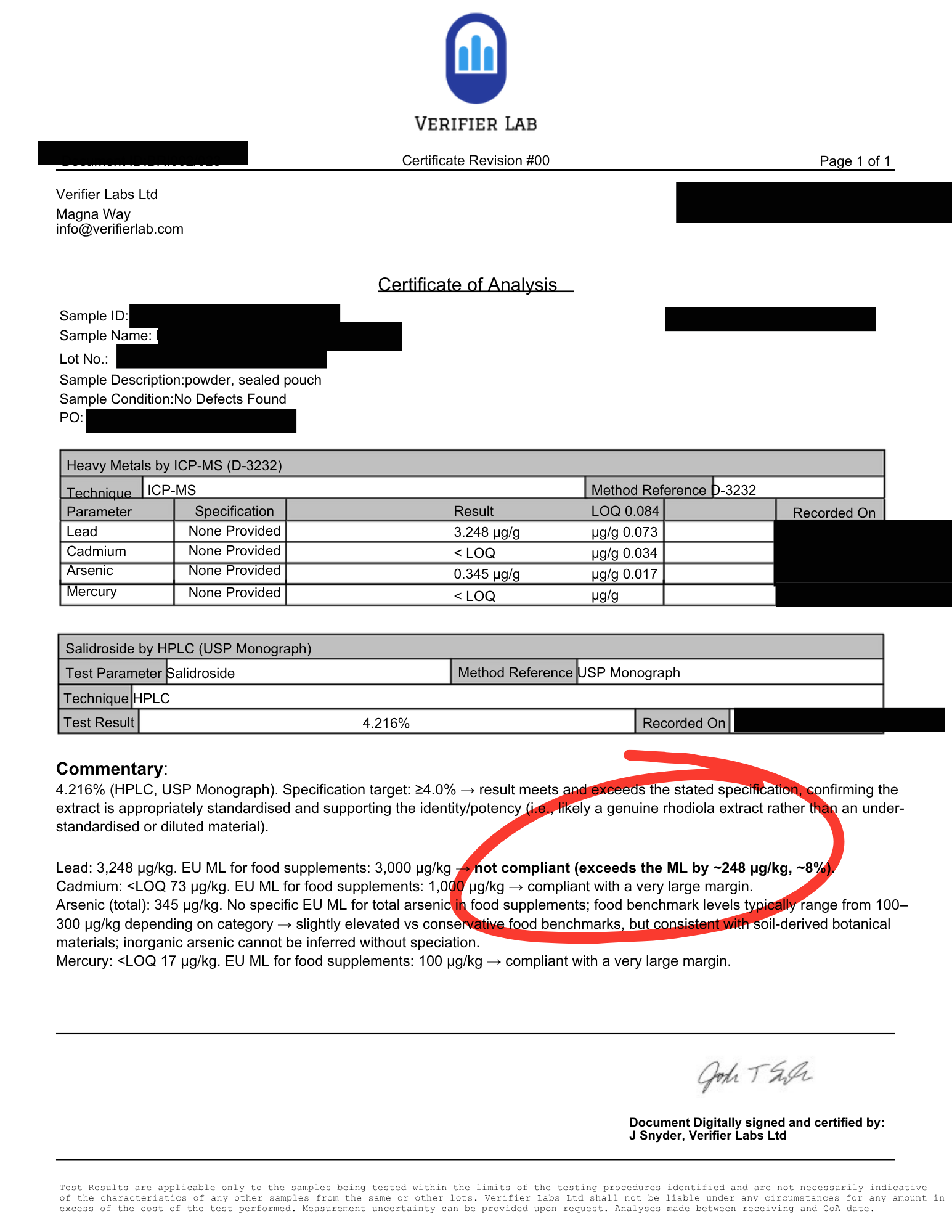
At Verifier Labs, we’ve recently tested multiple rhodiola products for clients and observed cases where lead levels were significantly higher than consumers would reasonably expect. In at least one recent sample, the measured lead content exceeded EU maximum limits for food supplements.
Importantly, this does not mean every rhodiola product is contaminated. We have also seen products that perform well and remain comfortably within regulatory limits. However, the findings reinforce an important reality about botanical supplements:
Consumers cannot reliably judge supplement safety based on branding, price, marketing claims, or packaging alone.
Why Can Rhodiola Rosea Contain Lead?
The answer largely comes down to agriculture and environmental exposure.
Rhodiola rosea is a root-based botanical. Like many medicinal plants, it absorbs minerals and compounds directly from the soil in which it grows. Unfortunately, plants can also absorb undesirable substances — including heavy metals such as lead.
Lead contamination may originate from:
- Naturally mineral-rich soil
- Industrial pollution
- Contaminated irrigation water
- Historical use of lead-containing pesticides or fuels
- Environmental fallout from nearby manufacturing or mining activity
Because rhodiola is often processed into concentrated extracts, contaminants present in the raw material can become more concentrated during manufacturing if appropriate purification and screening processes are not in place.
This is not unique to rhodiola. Heavy metal contamination is a known issue across many botanical supplements, particularly roots, mushrooms, seaweeds, and other plants grown in challenging environmental conditions.
Why Lead Exposure Is a Serious Concern
Lead is not a nutrient. It is a toxic heavy metal with no beneficial biological role in the human body.
Long-term exposure to elevated lead levels has been associated with:
- Cognitive impairment
- Neurological dysfunction
- Reduced attention and memory
- Cardiovascular issues
- Kidney damage
- Increased oxidative stress
- Developmental toxicity in children
This creates an especially troubling contradiction for consumers using rhodiola specifically to support mental and physical performance.
Many people take rhodiola to improve stress resilience, focus, energy, and overall wellbeing — yet chronic exposure to elevated lead levels may negatively affect several of those same systems.
The Problem With “Trust-Based” Supplement Purchasing
One of the biggest issues in the supplement industry is the lack of transparency surrounding testing.
Many companies advertise “lab tested” products, but very few provide actual data for consumers to review.
Even more concerning, some brands may only perform occasional testing rather than testing every production batch consistently.
This matters because contamination can vary substantially between batches depending on:
- The harvest source
- Soil conditions
- Seasonal variation
- Supplier changes
- Extraction methods
- Manufacturing controls
A clean test result from years ago tells consumers very little about the product being sold today.
What Consumers Should Look For
If you use rhodiola rosea — or any botanical supplement — there are several important things to look for:
1. Third-Party Testing
Testing should be conducted by an independent laboratory, not solely in-house.
2. Publicly Available Certificates of Analysis (CoAs)
Brands should publish their testing results openly so consumers can review the actual data themselves.
3. Heavy Metal Testing
The CoA should specifically include heavy metal analysis, ideally covering:
- Lead
- Cadmium
- Arsenic
- Mercury
4. Batch-by-Batch Testing
This is critical.
A responsible company should test every production batch, not just a single historical sample.
If a company cannot provide recent batch-specific results, consumers have no reliable way of knowing whether the product they are purchasing has actually been screened.
Transparency Matters
The supplement industry has a transparency problem.
Consumers are increasingly expected to simply trust marketing claims without access to meaningful verification data.
But when it comes to heavy metals, transparency is essential.
If a company genuinely performs rigorous testing, there should be no issue providing consumers with current batch-specific Certificates of Analysis.
At the end of the day, informed consumers make safer decisions — and proper testing is one of the most important safeguards in the supplement industry today.